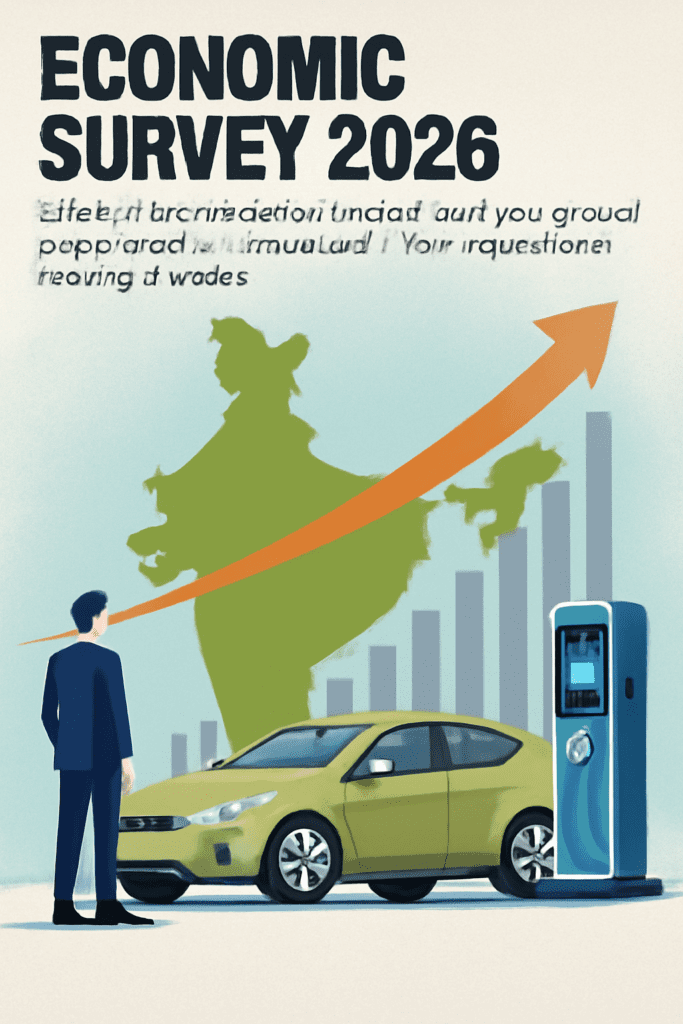

India’s electric vehicle (EV) market has expanded sharply over the last six years, clocking a 63 percent compounded annual growth rate (CAGR), according to the Economic Survey 2025–26 presented by Finance Minister Nirmala Sitharaman on January 29.
The survey noted that EV registrations rose to 1.97 million units in FY25 from 1.68 million in FY24, translating into a 16.9 percent year-on-year increase. By comparison, total registrations were only about 0.1–0.2 million in FY20.
Electric passenger vehicles also hit a milestone in FY25, with registrations topping 100,000 for the first time. This category grew 18 percent from the previous year.
Electric two-wheelers remained the backbone of the market. Registrations in this segment climbed 21 percent in FY25 to 1.15 million units, reinforcing their position as the biggest driver of EV adoption in the country.
The survey attributed the sector’s momentum to a series of central government measures aimed at accelerating electric mobility. Among them is the Production-Linked Incentive (PLI) Scheme for the Automobile and Auto Components Industry, cleared in September 2021 with an outlay of Rs 25,938 crore. Designed to encourage the production of high-value vehicles and components based on advanced automotive technology, the programme had drawn cumulative investments of Rs 35,657 crore up to September 2025.
A second major initiative is the PLI scheme under the National Programme on Advanced Chemistry Cell (ACC) Battery Storage, backed by Rs 18,100 crore to build 50 GWh of capacity. Of this, 40 GWh has already been awarded, a step the survey said supports localisation of battery manufacturing and strengthens the domestic EV ecosystem.
In September 2024, the government launched the PM E-Drive scheme with an allocation of Rs 10,900 crore. The programme offers demand incentives for electric two- and three-wheelers, extends support to newer categories such as electric trucks and ambulances, and also provides for charging infrastructure along with upgrades to vehicle testing agencies.
To accelerate electrification of public transport, the Centre in October 2024 notified the PM e-Bus Sewa–Payment Security Mechanism (PSM) scheme, with an estimated outlay of Rs 3,435.33 crore. The scheme seeks to enable the rollout of more than 38,000 electric buses by offering payment security to operators and original equipment manufacturers (OEMs) if public transport authorities default.
Earlier, the Society of Indian Automobile Manufacturers (SIAM) had said that government policy support, along with a rising pipeline of EV launches by automakers, has helped build strong momentum for EV adoption across India.